
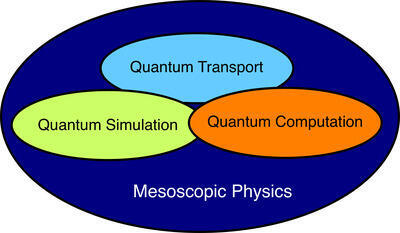
The research of Fabian Hassler’s group sits at the crossroads of mesoscopic physics, quantum‑information theory, and quantum optics. While maintaining its solid foundation in theoretical condensed‑matter physics, the group addresses a broader spectrum of topics that are directly relevant to emerging quantum technologies — and it does so in close, long‑term collaboration with experimental groups at RWTH Aachen and beyond.
Main Research Themes
| Theme | Focus | Typical Questions |
|---|---|---|
| Topological States of Matter | Classification, stability and manipulation of topological phases in low‑dimensional systems. | How can topological invariants be measured in realistic devices? |
| Topological Quantum Computing with Non‑Abelian Anyons | Theory of braiding, fusion and error‑correction schemes using non‑abelian excitations (e.g. Majorana zero modes). | What are scalable architectures for anyon‑based qubits? |
| Coherent Quantum Transport | Phase‑coherent electron flow in nanostructures, including time‑dependent driving. | What is the statistics of electrons in driven and/or interacting systems? |
| Non‑Equilibrium Phase Transitions | Critical behavior of driven‑dissipative quantum many‑body systems. | What universal properties emerge far from equilibrium? |
| Radiation Statistics of Quantum Emitters | Photon‑counting, squeezing and entanglement generation in solid‑state emitters. | How can emission statistics reveal underlying many‑body correlations? |
| 2D materials | Confinement, valley‑spin physics and transport in graphene‑based nanostructures. | What are good effective models for electrons confined in bilayer graphene? |
| Superconducting–Semiconducting Heterostructures | Hybrid platforms that combine superconductivity with strong spin‑orbit coupling. | How do proximity effects enable topological superconductivity? |
| Majorana Zero Modes | Realization, detection and manipulation of Majorana bound states in nanowires and 2D systems. | What are the most robust signatures of Majorana physics? |
| Time‑Dependent Transport with Non‑Abelian Anyons | Dynamical braiding protocols, Floquet engineering and transport signatures of anyonic excitations. | How can transport measurements unveil non‑Abelian statistics? |
Overarching Goals
- Understand topological and correlated quantum matter in both equilibrium and driven regimes.
- Identify experimentally accessible transport, spectroscopic, and photonic signatures of exotic quasiparticles.
- Develop theoretical frameworks for non‑equilibrium phase transitions and radiation statistics in quantum emitters.
- Explore scalable concepts for topological quantum computation, especially those involving non‑abelian anyons and Majorana modes.
Collaboration with Experimental Groups
A central pillar of the Hassler group is its active, long‑lasting partnership with experimental teams working on:
- Superconducting circuits and hybrid superconducting‑semiconducting devices
- Graphene‑based nanostructures and quantum dots
- Mesoscopic transport measurements and microwave‑photon detection
Through joint theory‑experiment projects, the group translates abstract models into concrete testable predictions, helps design experiments, and interprets results, thereby accelerating the development of topological quantum technologies and advanced quantum‑optical devices.
Former group members
PhD students:
- Christoph Ohm Quantum Measurements in Majorana Circuit Quantum Electrodynamics (2015)
- Jascha Ulrich Large impedances and Majorana bound states in superconducting circuits (2016)
- Daniel Otten Parity protected quantum computing in superconductors (2019)
- Lucía González Electron-hole diffusion in disordered superconductors (2021)
- Lisa Arndt (Otten) Parametric instabilities in driven-dissipative Josephson circuits (2023)
- Alexander Ziesen Two-dimensional Dirac systems (2024)
- David Scheer (2025)
Postdocs:
- Ananda Roy
- François Konschelle