
Group of Fabian Hassler
Master’s theses
Felix Boschke: Spectral Flow and Fractional Charge Pumping in Topological Insulators
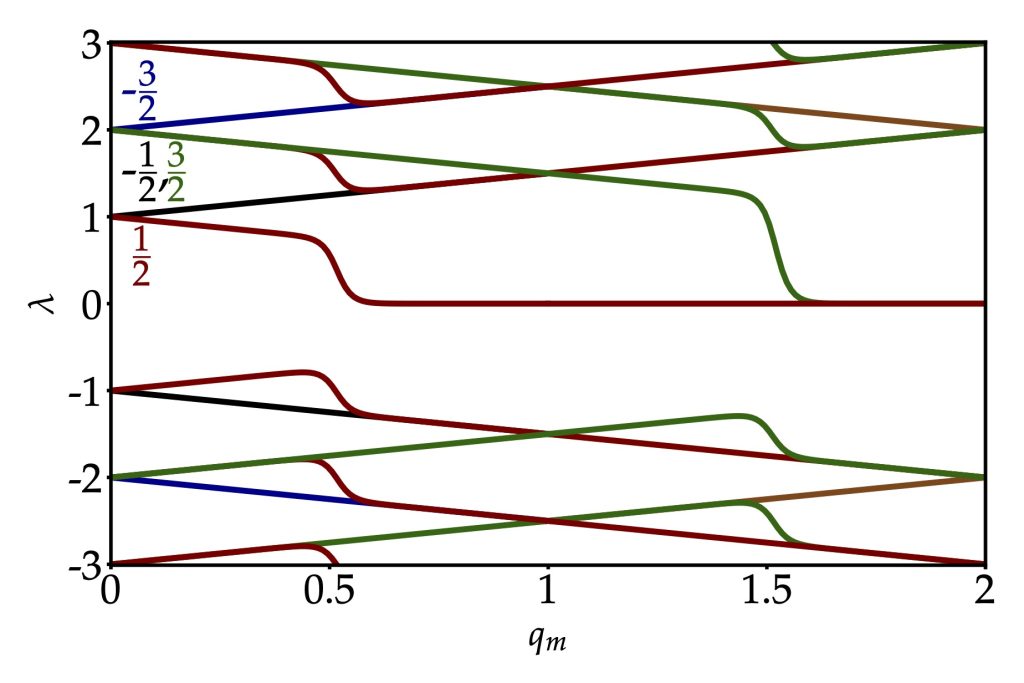
This thesis investigates the surface states of a spherical three-dimensional topological insulator (3D TI) containing a central magnetic monopole with a Dirac string. A magnetic monopole with an integer number of flux quanta in a 3D TI binds half-integer electric charge, which is known as the Witten effect. However, we analyze the effect of an unquantized magnetic flux which necessitates an additional boundary condition within a critical angular momentum subspace. To resolve this, we apply a momentum-squared regularization in a local flat-space limit that requires states to vanish at the string, uniquely fixing the boundary condition. This allows us to analytically determine the spectral flow of the system and it is shown how topological zero modes continuously form. Because zero modes carry half an elementary charge, the charge has to fractionalize during the formation of a zero mode. Thus, we further model the system as an adiabatic quantum pump to calculate the associated charge transport between the surface and monopole. By deriving states in the TI bulk, which are bound to the Dirac string, we demonstrate that during the formation of a zero mode half an electric charge is pumped between the surface and the monopole by the Dirac string, in accordance with the Witten effect. Thesis (PDF)
Grigorios Makris: Discretizing the sphere with an irregular lattice: Application to the transverse-field Ising model
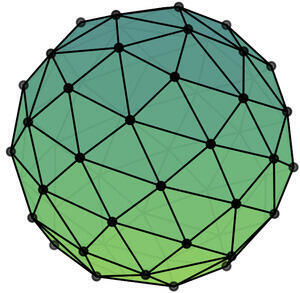
The thesis investigates the discretization of the sphere with irregular lattices, on which physical systems, and in particular the transverse-field Ising model, can be studied. More specifically, irregular lattices are necessary since, for arbitrary number of sites, the sphere cannot be covered with a regular grid. We solve the free particle problem on lattices that are easy to scale up and investigate if the expected SO(3) symmetry is recovered with increasing lattice size. The Fibonacci lattice is shown to be a good candidate for this. Having obtained the nearest neighbor hoppings for the free particle problem, we directly utilize them as interaction coefficients in the transverse-field Ising model placed on the Fibonacci lattice. With this choice of coefficients, the spin spectrum showcases better (approximate) degeneracies of the SO(3) compared to the case with constant coefficients. The search for the critical point of the system is halted due to pronounced finite-size effects. Thesis (PDF)
Steven Kim: Lindblad Equation, Symmetries, and Instabilities in Driven-Dissipative Systems
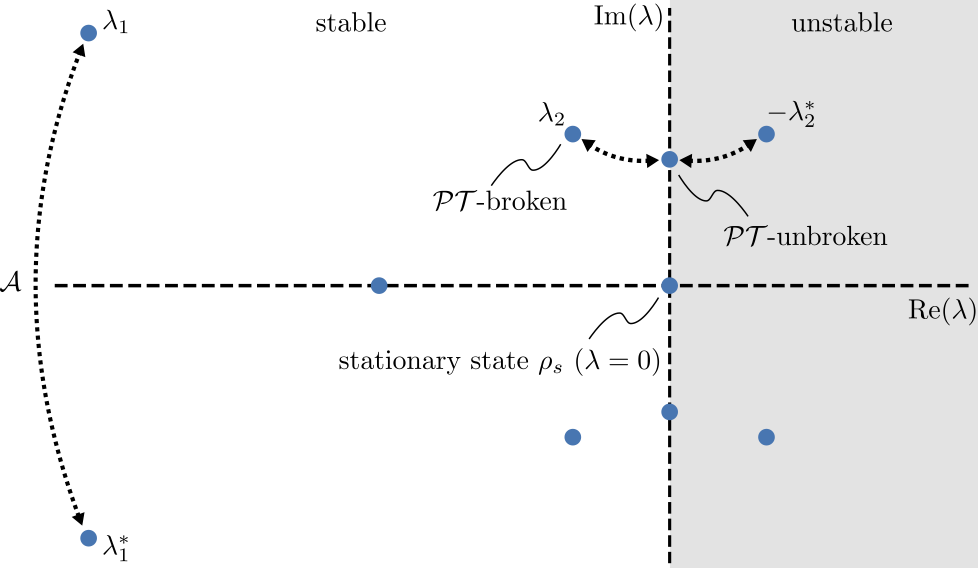
In this thesis, we study driven-dissipative systems that can be de- scribed by a Lindblad master equation. In particular, we analyze parametrically driven oscillators that exhibit an instability when the driving strength exceeds the damping. In this critical regime, both fluctuations and nonlinearities have to be included for an accurate description of the system. For the degenerate parametric oscilla- tor, it has been shown that the long-time dynamics can be described by a universal Liouvillian. This makes the efficient calculation of observables, such as the photon current, possible. To determine the long-time dynamics, we provide a method to solve the Lindblad equation, which makes the separation of timescales possible. This is used to derive the effective model for the non-degenerate parametric os- cillator, and we analyze the resulting statistics of radiation. Additionally, we discuss how symmetries of the Lindblad equation are described. Thesis (PDF)
Anton Montag: Hexagonal Majorana fermion lattice constructed from topological insulator Josephson junctions
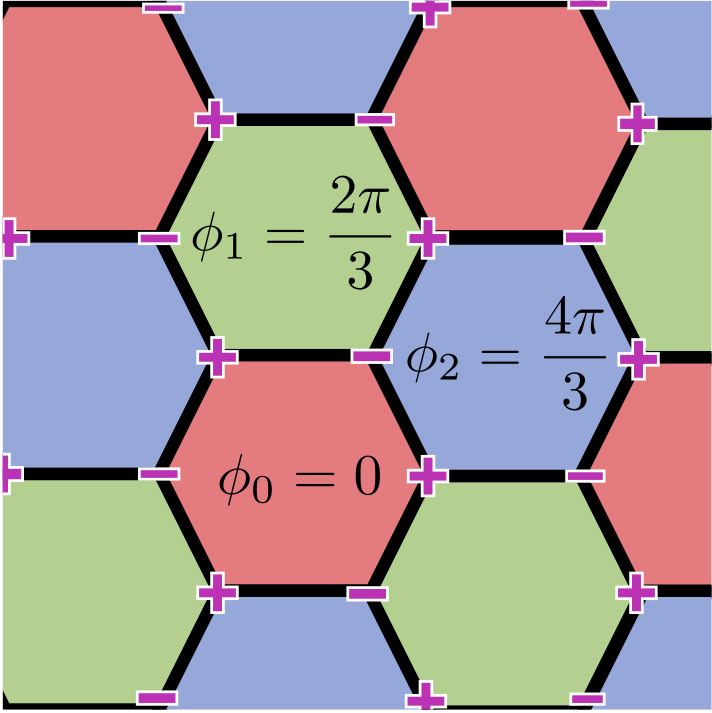
In this thesis, we discuss the realization of a hexagonal Majorana fermion lattice and its thermal transport properties. We analyze the two-dimensional Josephson junctions on the surface of topologi- cal insulators to obtain topological Majorana wires in the low-energy regime. Using this description of the wires, we construct trijunctions and derive three distinct topological phases of them, two of which host Majorana bound states. We connect multiple Majorana bound states with topological insulator Josephson junctions to a hexagonal lattice of Majorana fermions. The spectrum of this lattice is calculated, the appearance of edge states is shown, and the scaling behavior of the thermal conductance of the hexagonal Majorana lattice is analyzed. Thesis (PDF)
Alexander Ziesen: Lattice Gauge Theoretic Analysis of Topological Ordering in the Majorana Toric Code
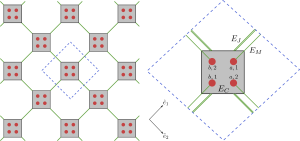
In this thesis, we consider a two dimensional square lattice of mesoscopic superconducting islands carrying four Majorana zero modes (MZM) each. We consider the islands to form an array of Josephson junctions, where the MZM allow for additional inter-island single electron transfer. This model is known to realize topological order in the form of Kitaev’s toric code. With a calculation of the effective Hamiltonian, we prove that the presence of charge-2e Josephson tunneling has a stabilizing effect on the toric code gap. The goal of this thesis is to investigate the signatures of topological ordering. To this end, we introduce a duality mapping of the MZM to spins yielding a lattice gauge theory and shift the focus from the matter to the gauge perspective. In this form, we can utilize the equal time formulation of the Fredenhagen-Marcu order parameter, a generalized Wilson loop, to detect the topological signatures and give an intuitive picture of (open) loop condensation to understand the topological phase
transition. Thesis (PDF)
Lisa Arndt: Dual Shapiro steps of a phase-slip junction in the presence of a parasitic capacitance
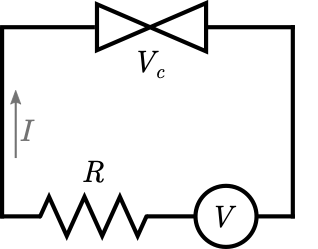
This thesis investigates the emergence of dual Shapiro steps in the IV-curve of a single Josephson junction in the phase-slip regime. In particular, we analyze the detrimental effect of the parasitic capacitance between the biasing lines and how it can be remedied by an on-chip superinductance. We obtain an explicit analytical expression for the height of dual Shapiro steps as a function of the ratio of the parasitic capacitance to the superinductance. Using this result, we provide a quantitative estimate of the dual Shapiro step height. Our calculations reveal that even in the presence of a parasitic capacitance it should be possible to observe dual Shapiro steps with realistic experimental parameters. Thesis (PDF)
Florian Venn: Algebraic Methods for the 1D Schrödinger Equation
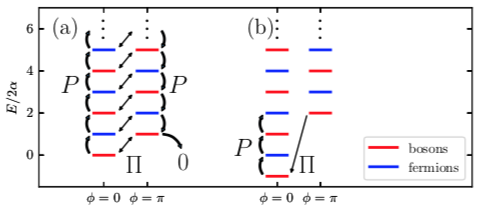
We discuss algebraic methods to obtain exact results about the eigenvalue spectrum of the one dimensional Schrödinger equation. We focus on degeneracies in the spectrum and eigenvalues that are exactly solvable. The central object in our discussion is supersymmetry. First, we give an introduction to the description of problems using superpotentials. We present insights that can be obtained from the supersymmetric structure, in particular the degeneracies between bosonic and fermionic states and that the groundstate admits an algebraic solution. We use these insights to study the double sine potential. By tuning the double sine potential away from the point where it can be described using supersymmetry, we find an extension of supersymmetry that is related to a class of problems for which multiple eigenstates admit algebraic solutions. Next, we prove, for a subclass of these problems, that a degenerate partner state exists for almost all eigenstates. Finally, we highlight that the class of periodic problems with more than one exactly solvable eigenvalue is not limited to the double sine potential. Thesis (PDF)
Elias Walter: Influence of chiral symmetry on electron scattering at disordered graphene boundaries
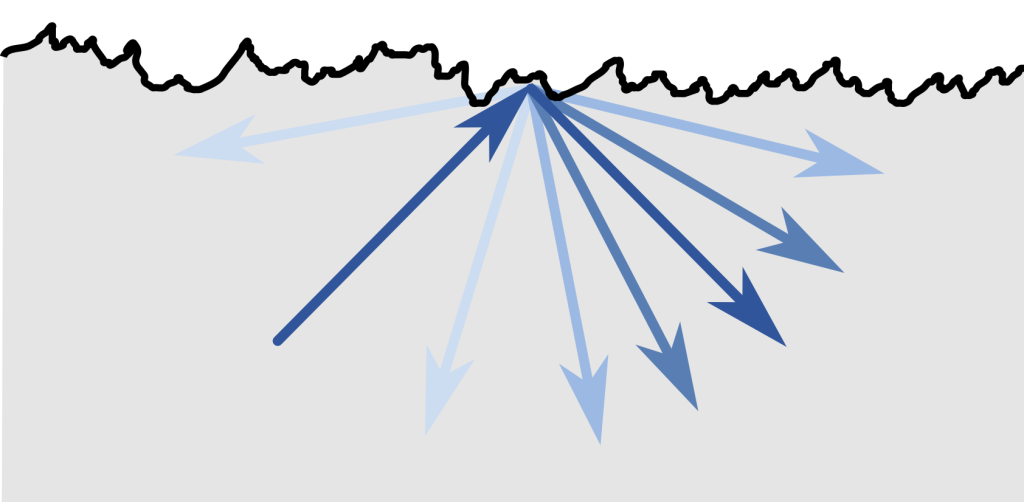
In this thesis, we study scattering processes at disordered graphene boundaries. In particular, we investigate how the chiral symmetry of quasiparticles in graphene influences diffusive scattering. We find that a boundary that breaks chiral symmetry behaves like a mirror, in the sense that in the long Fermi wavelength limit diffusive scattering is suppressed and incoming electrons are reflected specularly. However, if the disorder on average preserves chiral symmetry, diffusive scattering increases significantly, leading to a breakdown of the mirror-like behavior. Thesis (PDF)
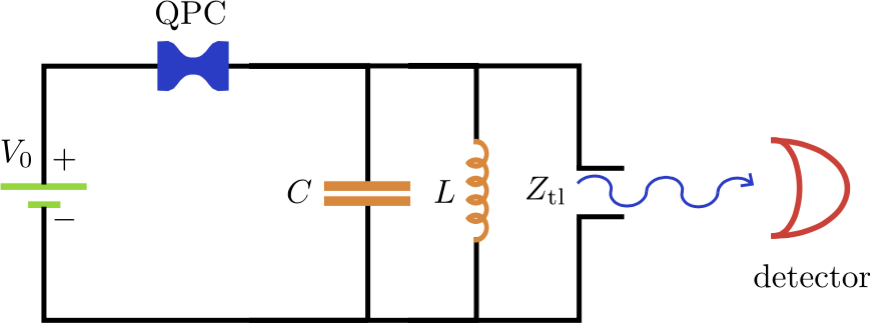
Daniel Otten: Second-Order Coherence of Microwave Photons Emitted by a Quantum Point Contact
In this work we present a diagrammatic approach to calculate current cumulants for the electron transport through a quantum point contact. We provide compact expressions for cumulants up to and including the third order. Furthermore, fluctuations in the electronic current lead to emitted radiation in the microwave regime. In this context the current cumulants are linked to the photon counting statistics of the microwave field. For this setup, we calculate the Fano factor F and the second-order coherence function g(2)(τ). Thesis (PDF)
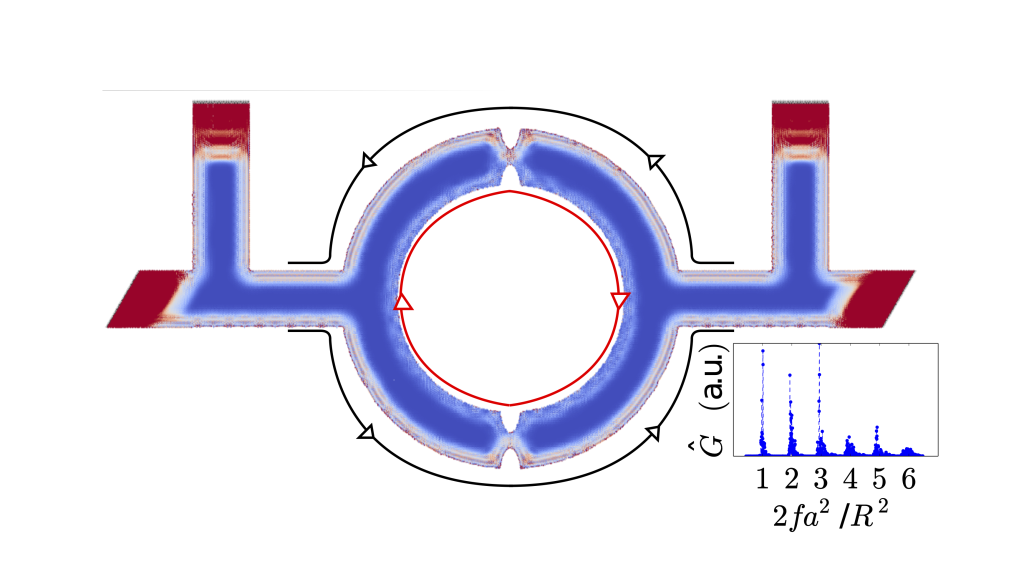
Dominique Dresen: Quantum Transport of Non-Interacting Electrons in 2D Systems of Arbitrary Geometries
The scattering formalism for describing the trans port properties of systems is discussed. We apply the formalism to GaAs and graphene with different geometries and types of disorder. For example, we discuss impedance matching of graphene to outside leads, Aharonov-Bohm effect in a ring geometry, and how strain-fluctuations in graphene manifest themselves in the transport properties. Thesis (PDF)
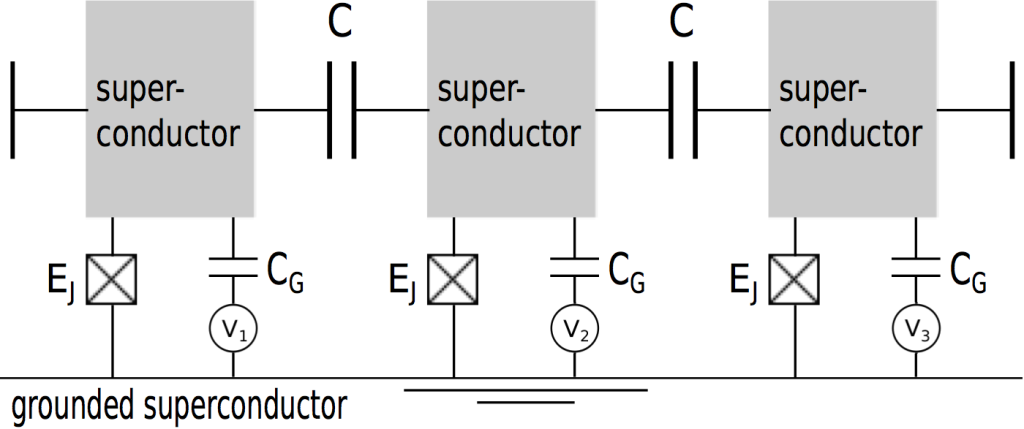
Sebastian Rubbert: Tuneable Long Range Interactions in an Array of coupled Cooper Pair Boxes
The Kitaev chain emulating the transverse Ising model can be implemented in an array of superconducting islands with semiconducting nanowires. In this thesis, we will show that adding additional capacitances to the system implements a long-range interaction between the Ising degrees of freedom. Thesis (PDF)
Bachelor’s theses
- Emma Falke: Numerical Computation of Spectra of Non-Hermitian Operators
- Aristid Großmann: Thermodynamic Uncertainty Relation in Superconducting Circuits
- Jonas Völler: Stabilizing Josephson radiation in the presence of thermal noise
- Emily Büschges: Electron-hole excitations in a ring driven by a time-dependent Aharonov-Bohm flux
- Maximilian Hauke: Effects of noise on dual Shapiro steps
- Apostolos Siskou: Fluctuation of radiation emission near a parametric instability
- Fynn Janssen: Period tripling in a parametrically driven Duffing-oscillator
- Yves Rottstaedt: Supercurrent diode effect
- Steven Kim: Single mode Lindblad description of the parametric instability
- Leona Rodenkirchen: Different Approaches to Stochastic Quantization in One-Dimensional Processes
- David Scheer: Escape from a metastable state due to thermal fluctuations described by path integrals